by John Shively, Executive Director of Mission
“This we know. … All things are connected,” wrote Chief Seattle. At the time, Chief Seattle led the Duwamish, Suquamish, and allied Indigenous tribes—and this quote comes directly from a letter to then-U.S. President Franklin Pierce.
The U.S. Government at the time wanted to purchase the lands his people lived on. In the letter, he explains, while considering the offer:
“This we know: the earth does not belong to man; man belongs to the earth. This we know. All things are connected … Man did not weave the web of life: he is merely a strand in it. Whatever he does to the web, he does to himself.” It seems, perhaps far too late, that we are finally beginning to wake up to this spiritual wisdom.
Lessons From a Pecan Grove
As a young boy growing up in Southeast Kansas, every year on the third weekend of September, I would go camping with friends and family. We would camp on this same patch of land nestled underneath the canopies of a pecan grove. One year when the forest floor was carpeted with hundreds of bright green pecan husks dropped from an early frost, I remember carrying bundles-full in my jacket back to camp. I would set to work shelling them, staining my hands and clothes green, much to my mother’s displeasure.
You see, it was a mast fruiting year for the pecan trees. Pecan trees do this not only for the survival of the tree but also for the survival of the forest. As Robin Wall Kimmerer explains in her book “Braiding Sweetgrass,” “The pecan groves give, and give again. Such communal generosity might seem incompatible with the process of evolution, which invokes the imperative of individual survival.
But we make a grave error if we try to separate individual well-being from the health of the whole. The gift of abundance from pecans is also a gift to themselves. … Together, the trees survive, and thrive.”
If Trees Could Talk
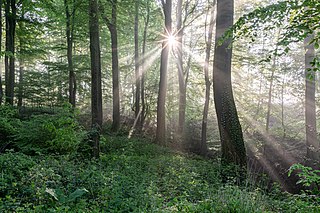
The scientific story about how trees grow and produce used to look at each individual tree. The consensus was that each tree stood alone. Kimmerer explains, however, that for Indigenous people, “In the old times, our elders say, the trees talked to each other. They’d stand in their own council and craft a plan.”
Science has recently learned that trees do communicate with each other, both above and underground. The mycelium fungi present in the forest roots help trees communicate and distribute water and nutrients, their mutuality and relationship ensuring their survival.
As Peter Wolleben explains in “The Hidden Life of Trees,” when we begin removing trees to reduce
supposed competition, the remaining trees are harmed. Even though the remaining trees grow faster, he says, they don’t live for very long: “This is because a tree
can be only as strong as the forest that surrounds it.”
The gift of the forest is a reminder that we need one another, to share in each other’s abundance, hardship, joy, and grief. By living in generosity, abundance, and mutuality, we ensure the strength of the community.
Challenging Individualism
So, what does that have to do with integral ecology?
Well, I would argue “everything!” Just as scientists thought trees once lived and grew in isolation, our cultural story continues to focus on individual flourishing and achievement: that people are self-made, succeeding or failing on their own merits; that people, in a sense, “get what they deserve.”
The narrative of the self-made person, who should be concerned only about the self, is a mythos that influences every part of our social imagination. We mainly inherit this narrative from mainstream economics and capitalism, although it is dominant elsewhere in our lives. Integral ecology provides a counternarrative: one that argues we belong to each other, have obligations to each other, and find humans flourishing in mutuality.
Integral ecology challenges us to change the way we see the world, its problems, and potential solutions. At its core, integral ecology is a lens that asks us to see the interconnectedness of all life. Pope Francis repeats many times in his encyclical Laudato Si’ that everything is connected! In these words, we hear the echoes of Chief Seattle, “This we know. … All things are connected.” In light of this, we are called to examine the relationships between humans and all the systems that make up the wholeness of human existence.
As Pope Francis writes in his book Let Us Dream: “…we might remember the truth that God put in our hearts: that we belong to Him and to each other.” Similarly, Fr. Greg Boyle, founder and director of Homeboy Industries, challenges us to “disrupt the notion that it’s possible there are people who are not our own, who don’t belong to us.”
Nurturing Roots of Change
Given all this, I know some may be asking, “Where are we now in this journey?” Political scientist Max Weber once described politics as “a strong and slow boring of hard boards.” If that’s the case, I would posit that the work of transformation is the strong and slow growing of deep roots. And while we’ve certainly begun to plant, we know that roots take time, patience, and care to grow. We must allow for God’s providence to guide us in our work and for these roots to grow our individual trees into a deeply interdependent forest.
The vision of integral ecology celebrates mutuality and abundance that continues to grow, deepen, and bear fruit elsewhere through:
- The work of exploring our commitment to land justice
- An evolving inclusion of employees and Associates into our understanding of community
- Our work for the poor and the marginalized through the systemic change process
- The many individual ministries
- And much more to come!
The gifts of the forest abound if we take the time to see where our roots have grown.