n June 27, 2025, the SCL Land Justice Interest Group hosted a workshop titled “Roots of Injustice, Seeds of Change: Toward Right Relationship with Native Peoples.” The session brought together participants to examine Indigenous history and contemporary land justice issues through an interactive educational experience.
The Exercise: Representing Turtle Island
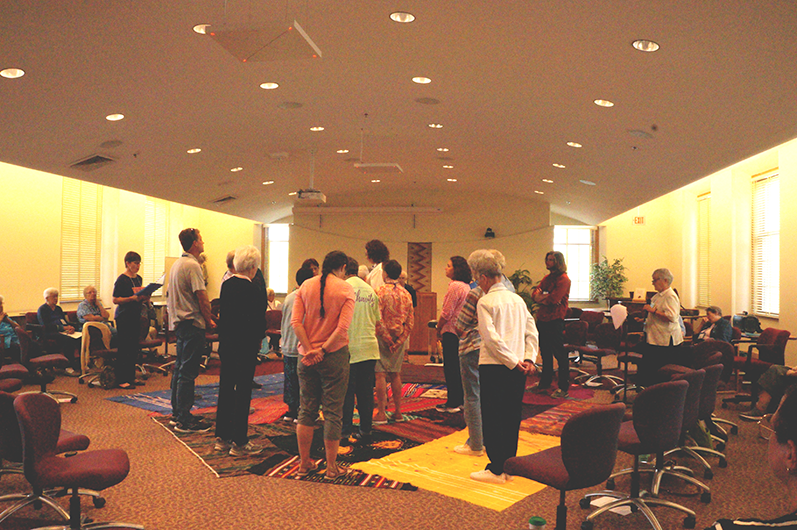
The workshop began with volunteers standing on colorful blankets arranged on the floor, representing the original territories of Turtle Island—the Indigenous name for North America. Those standing represented the continent’s original inhabitants: an estimated 30 million people from 800 distinct nations, each with unique languages, cultures, and governance systems before European contact.
Participants were asked to imagine the landscapes their represented peoples would have known—the sights, sounds, and environments where Indigenous communities had established their homes over millennia.
Historical Framework: The Doctrine of Discovery
The educational narrative began with the “Doctrine of Discovery,” in which European Christians took part in the “capture, vanquish and subdue all pagans and other enemies of Christ” and “reduce their persons to perpetual slavery.” The workshop positioned this papal bull as a foundational document that justified centuries of territorial appropriation and cultural suppression.
As the historical timeline progressed, participants holding different colored cards gradually left the blankets. Pink cards represented those who died from European diseases, blue cards those removed during events like the Trail of Tears, yellow cards those who died in conflicts or from starvation, and red cards children who died in boarding schools or suffered lasting trauma from forced assimilation policies.
By the exercise’s conclusion, only a few participants remained on the blankets that had initially been crowded with representatives of diverse Indigenous nations.
Contemporary Context
The workshop connected historical events to current demographics and health outcomes. Native Americans currently comprise less than 2% of the U.S. population and retain approximately 2% of their original territorial holdings. The facilitators noted that during the COVID-19 pandemic, Native American life expectancy dropped to 65 years, 11 years below the national average.
The session also addressed the systematic nature of land dispossession, including the Allotment Act of 1887, the boarding school system’s assimilationist goals, the breaking of 400 treaties, and the historical practice of offering bounties for Native people’s scalps.
Institutional Accountability
Several participants, particularly the Sisters in attendance, responded to information about the Catholic Church’s role in the Doctrine of Discovery. One participant commented on the difficulty of confronting their institution’s historical involvement, expressing the challenge of acknowledging such actions within their faith tradition.
The workshop noted that the Vatican repudiated the Doctrine of Discovery in March 2023, though facilitators suggested this statement did not constitute complete acknowledgment of historical harms.
A Model for Reconciliation
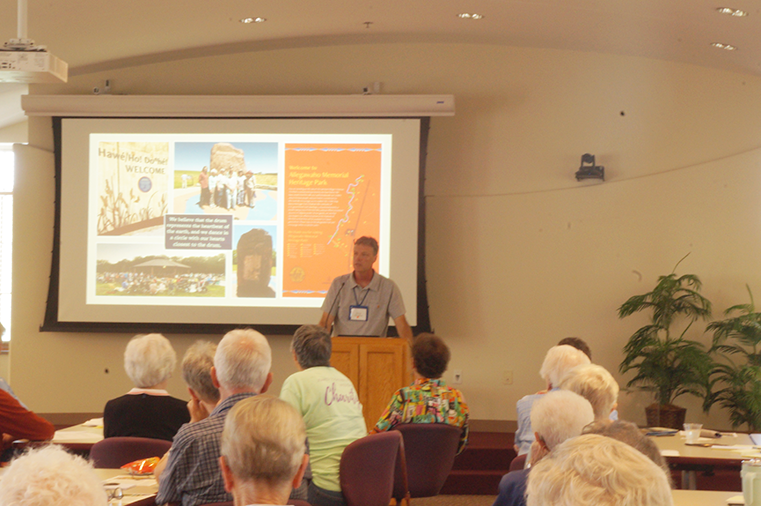
The session concluded with the story of Ronnie O’Brien, a Nebraska gardener who contacted the Pawnee Tribe in Oklahoma about their historical presence in the region. Learning that sacred Pawnee corn seeds no longer thrived in Oklahoma’s different soil conditions, O’Brien offered to cultivate them in their original Nebraska homeland.
According to Deb Echo-Hawk, the Pawnee seed keeper, “The corn remembered the land it came from. Now the descendants of the settlers in Nebraska are growing Pawnee corn and sending it back to us here in Oklahoma. We have renewed the friendship between the Pawnee people and the settlers, and this friendship has become a part of the Mother Corn cycle.”
This example illustrated potential pathways for constructive engagement between Indigenous communities and non-Native populations.
Beyond Land Acknowledgments
While many institutions now begin gatherings with land acknowledgments recognizing Indigenous territorial history, the workshop presented these as initial steps rather than complete responses. The “Land Back” movement encourages more substantive actions, including voluntary rent payments to tribes, donations to Native organizations, land returns to tribal control, and providing access for traditional gathering and ceremonies.
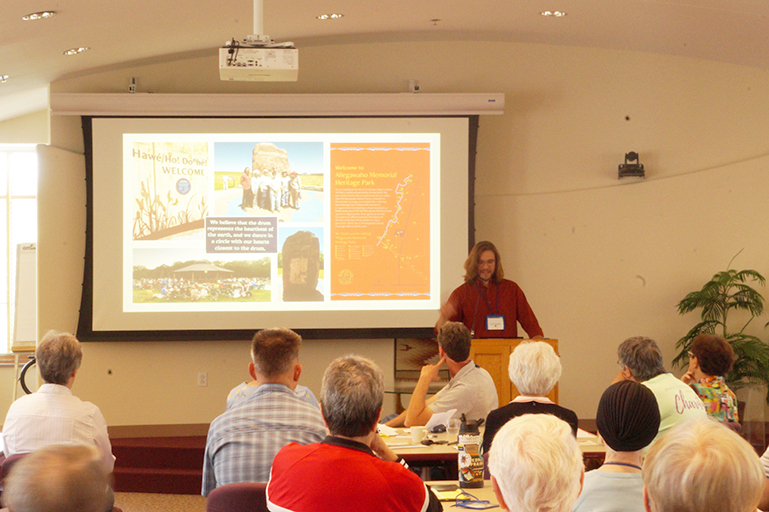
During the afternoon, the SCL Land Justice Committee presented photographs and a report of their recent visit to the Washunga Days Powwow in Council Grove, Kansas. Then, the entire group reviewed a draft of a land ethic document, and the Land Justice Committee received feedback for further revisions.
Moving Forward
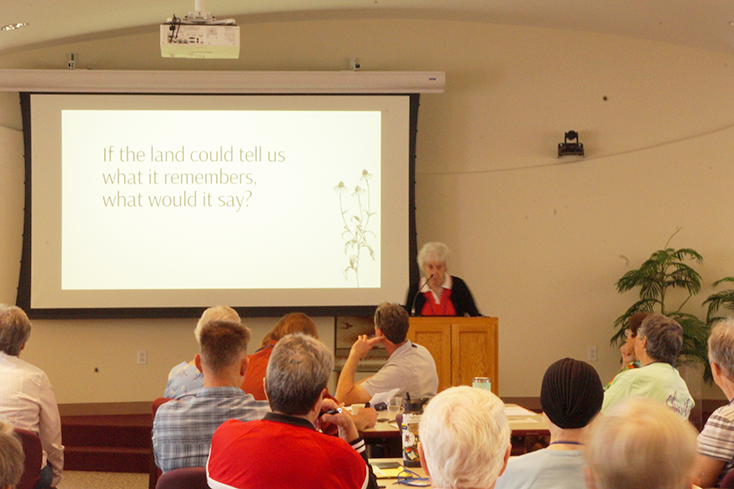
Each participant received a corn kernel as a reminder to consider potential contributions to positive change. Quoting Rio Ramirez of the Tohono O’odham Nation, the presenters emphasized collective responsibility: “We are the ones who are living now, and we need to understand that we are all in this together.”
The workshop concluded with participants forming a circle and reciting words from the Yokuts people of California: “With the great rocks, with the great trees, my words are tied in one with my body and my heart. All of you see me one with this world.”
The session aimed to move participants beyond familiar historical narratives to an understanding of the ongoing impacts of colonization and to consider their roles in addressing contemporary Indigenous issues. Rather than focusing on individual guilt over historical actions, the workshop emphasized understanding current systems and working toward what facilitators termed “right relationship” with Indigenous peoples and the land.