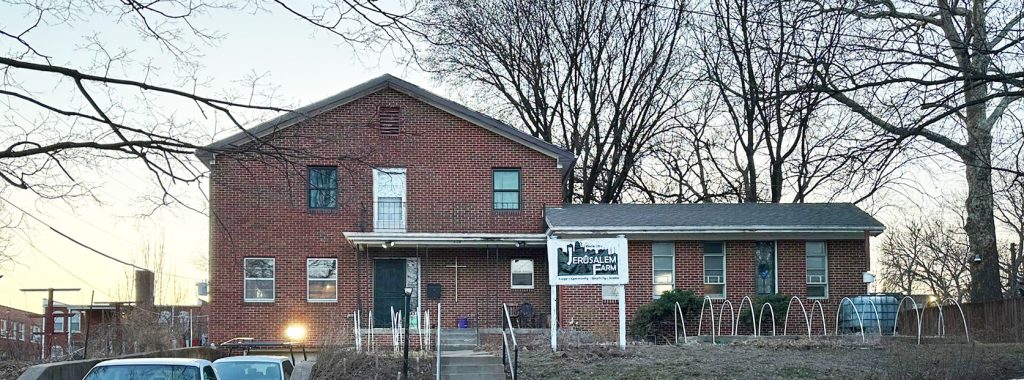
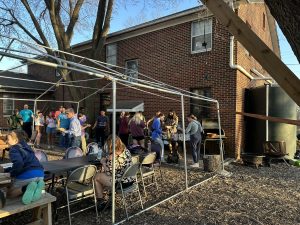
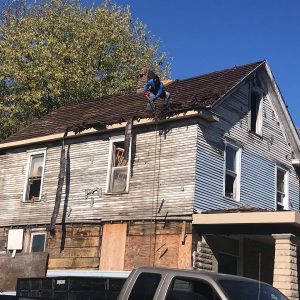
Jerusalem Farm is a Catholic intentional community dedicated to transforming lives through service and sustainable living. In the Historic Northeast neighborhoods of Kansas City, Missouri, Jerusalem Farm (J-Farm) welcomes high school and college students for week-long immersion experiences that blend service with Catholic Social Teaching. The community’s members lead and assist volunteers in home repair and environmental projects for low-income residents of the Historic Northeast.
“We have our four cornerstones: prayer, community, simplicity, and service,” explains Jordan Schiele, who co-founded J-Farm with his wife, Jessie. “We see the volunteer program fulfilling all four of these cornerstones, as well as an opportunity to share Catholic Social Teaching with high school and college students and model service in the community.”
The standard volunteer week runs from Sunday evening to Saturday morning. Each day begins with prayer led by J-Farm community members, with volunteers eventually taking on this responsibility as the week progresses. “As Catholics, our understanding of prayer is typically the Mass or the rosary or different memorized prayers,” notes Schiele. “But for our periods of gathering for prayer, it could involve conversation, dialogue, art, silence, movement, scripture—whatever medium that will direct people towards God and one another.”
After breakfast, volunteers head to various work sites throughout the day. They return in the afternoon, share dinner, participate in evening prayer, and enjoy some downtime.
An educational component occurs on Mondays when volunteers take a three-hour neighborhood walk focused on Catholic Social Teaching. “We introduce them to the seven themes of Catholic Social Teaching ,” Schiele explains. “We try to talk about them in concrete ways in which the volunteers will be able to see and experience these concepts through our work during the week, but also through the lens of our neighborhood and urban living.”
While on the neighborhood walks, Schiele helps students analyze urban challenges through this framework: “We might talk about the preferential option for the poor and vulnerable…how we might, as a society, approach this situation differently.”
This critical engagement helps students move beyond surface-level service to an understanding of the systemic issues affecting communities.
Building Bridges in Divided Times
The impact of these experiences can be long-lasting. “We have an individual named Jack who lives in St. Louis now and works for Catholic Charities,” Schiele shares. “He told me, ‘I came on a retreat seven years ago, and it completely changed my life—my attitude towards service and what I want to do.’” Jack briefly joined the seminary because of his experience at J-Farm before eventually pursuing social work.
J-Farm intentionally brings together diverse groups for each retreat week. “We might have three different schools come, and they’re all going to bring eight to 12 people,” says Schiele. “We’re bringing together people from across the country with different experiences. We sometimes have Cristo Rey schools that come here, and those students are coming from even different backgrounds than the typical, say, wealthier Jesuit school.”
Schiele sees this diversity as essential in our current cultural climate. “We live in a pretty divided time. I view these retreat opportunities, these immersion trips, as a way for people to encounter one another,” he explains. “These weeks are a great opportunity to build unity and reorient ourselves to one another and each other’s humanity and tie it all together with what it means to be Catholic.”
By serving in Kansas City’s Northeast neighborhoods, which Schiele describes as “some of the most diverse neighborhoods in all of Kansas City,” students engage with people from different economic backgrounds. This challenges the volunteers to move beyond political divisions and view faith in a broader human context.
Like teachers planting seeds, the J-Farm team never knows which experiences will transform a young person’s life. But through their commitment to prayer, community, simplicity, and service, they continue creating opportunities for meaningful encounters that often bear fruit for years to come.
Goat Squad
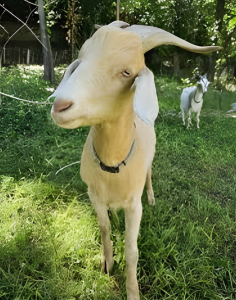
Jerusalem Farm has 11 goats working hard to restore Kessler Park, a 300-acre green space in the Historic Northeast of Kansas City. Their mission? To clear invasive species and restore the park’s natural habitat.
The goats are incredibly efficient, clearing about one acre every two months. A dedicated shepherding team provides them with water, additional food, and supervision. Every two to three weeks, J-Farm organizes volunteers to remove trash, clean the goat trailer, and migrate the fencing to create a new grazing paddock.
The goats are more than just workers—they’re community ambassadors! They’ve been invited to neighborhood events where local residents are thrilled to meet them and create a rural connection within the urban core. Citizens visit the park to watch these “goofy creatures” work, learn about habitat restoration, and enjoy nature in the city.
J-Farm’s goats and volunteers work to counter the spread of invasive species like bush honeysuckle, which can grow 15-20 feet tall and disrupt native ecosystems. By grazing, these goats not only remove invasive plants but also restore nutrients to the soil—proving that sometimes the most effective ecological tools have hooves!
Ecological Highlights
The J-Farm goats have:
- cleared five+ acres of invasive species
- enabled J-Farm to plant over 200 native trees
- enabled J-Farm to spread over 100 pounds of native seed
- contributed to 2,000+ volunteer hours in Kessler Park