In a rare convergence of events that captured worldwide attention, the election of Pope Leo XIV occurred during the International Union of Superior Generals (UISG) meeting in Rome, bringing together two significant gatherings of Catholic leadership at a pivotal moment for the Church.
 Sister Eileen Haynes, Community Director of the Sisters of Charity of Leavenworth, was among the 900 women religious leaders in the UISG meeting a few miles from the Vatican when white smoke appeared above the Sistine Chapel. “We had just finished receiving Communion at Mass when the ripple just went through the room,” she recalled. “People were standing up, singing Hallelujah. Everybody was out dancing and shouting.” Some sisters immediately left for the Vatican to witness the historic announcement.
The election held special significance for Sister Eileen because it happened on her birthday. “I was getting text messages like crazy: ‘Eileen, what a great birthday gift,'” she shared. Adding to the historic nature of the moment was the election of the first Pope from the United States. “I can’t believe he’s from the United States. That is phenomenal,” Sister Eileen remarked when she heard the new Pope was from Chicago.
The UISG gathering itself represents a crucial but often less visible aspect of Church governance, bringing together female leaders who oversee religious communities serving millions worldwide. These women direct educational institutions, healthcare systems, social service organizations, and ministries in some of the world’s most challenging environments. Their triennial meeting provides a rare opportunity for global collaboration and sharing of experiences across cultural and geographic boundaries.
Beyond the papal election, these UISG conversations revealed extraordinary courage in challenging environments, including stories from Myanmar, where sisters stood between military forces and the children in their care, and accounts from the U.S.-Mexico border, where religious communities adapt their ministries to shifting political realities.
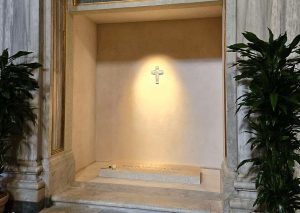 During her time in Rome, Sister Eileen also visited Pope Francis’s tomb, describing it as “quite unassuming” yet profoundly moving. “There was an absolute reverence. Tears just came,” she recalled of the experience where visitors stood elbow to elbow in silent respect—a moment connecting the Church’s recent past with its emerging future.
Sister Eileen sees hopeful continuity in Pope Leo XIV’s papacy: “He will continue, I think, with what he had said, Francis’s legacy of unity and peace, and all are welcome, all are loved by God.” She noted the significance of his name choice: “Pope Francis intentionally choosing Francis and Pope Leo intentionally choosing that name sets the direction.” The relatively quick conclave suggested to her that the cardinals wished “to continue on the same path of unity and calling all people to God.”
Perhaps most significant was the symbolic convergence of the Church’s leadership, as cardinals gathered in conclave while women religious leaders met nearby. “The male heads of our church and the female heads of our church,” as Sister Eileen described it, united in purpose during a transformative moment. As the conclave began, the UISG sisters sang “Veni Sancte Spiritus” for five minutes, spiritually joining the cardinals in their discernment.
This parallel gathering of male and female leadership transcends coincidence, embodying a living witness to a Church where diverse voices contribute to a shared mission of compassion and hope—a testament to the universal call that has echoed from St. Peter’s Square through centuries and continues to resonate in new ways under Pope Leo XIV’s guidance.